Below are frequently asked questions about Flourish as a program and the Flourish in Schools research study. If your question is not answered here, please reach out to the study coordinator: wine@upmc.edu

Flourish is a brief text messaging and web-based program designed to help youth manage negative social media experiences while dialing into positive experiences. Youth can use Flourish whenever they like. It has 3 components that are meant to offer support after negative online interactions:
- The coping skills section is a library of brief coping skills that are meant to be helpful either in moments after experiencing negativity online, or just if the user is having a bad day or struggling. Some skills help with embracing and tolerating stressful moments. Others are helpful in taking steps toward relaxation to reduce feelings of worry or stress. The skills use text, audio, and video-based content.
- The help-seeking section is personalized to each user. This section is pre-filled with friends, trusted adults, and others who the user would feel comfortable going to for distraction, “venting,” or when they need help. If the user is nervous or unsure about reaching out, Flourish can help them reflect on their hesitation and address it to help them feel more comfortable reaching out. Flourish never contacts someone on their behalf.
- The dealing with negativity section helps the user understand online social interactions which are not always easy to interpret and offers some suggestions about how they could respond. For example, a lot of youth talk about how hard it is to figure out whether it makes sense to respond back to the person saying something hurtful or if it’s better to just block them. This section helps the user choose a strategy to deal with the negativity and cultivate a positive environment online.
Flourish also initiates contact with the user on an automated basis.
- Questionnaires: Every 3 days, Flourish will send a short questionnaire to help the user reflect on their online experiences over the last few days. This helps bring awareness to whether they are having online experiences that are positive, negative, or somewhere in between.
- Skill of the day: The user also has the option to set reminders to use Flourish that we call “skill of the day.” These are friendly messages that suggest trying a certain skill.
Flourish is operated by a friendly character named Sprout, who will guide participants through questions and reflections about online interactions, offer support, and make suggestions like reaching out for help or problem solving a difficult situation. Flourish contains different mediums of information including pictures, infographics, text content, links to websites, or links to videos. Sprout will reach out a few times a week, though the program is self-paced, meaning students can initiate the program whenever they like and message Sprout as little or as often as they would like.
Flourish is a chatbot, meaning it is not a real person messaging your child on the other end, but rather technology programed to respond to close-ended questions. Flourish’s responses are not generated on the fly, and it is not generative AI, so it is not like ChatGPT coming up with a response on the spot. Your child will not be invited to write sentences or words to respond to Sprout. Rather, Sprout will communicate with multiple choice questions that allow the student to navigate the program, for example, “Type ‘1’ for ‘Yes’ or type ‘2’ for ‘No.'”
The purpose of this study is to determine if a brief, digital intervention (Flourish) for middle and high school students can reduce the mental health impacts of negative online interactions (online bullying, harassment, or discrimination). This study takes place over 3 months and involves the following:
- A 4-week text messaging and web-based program that provides information about using social media wisely, coping skills, and help-seeking resources.
- Answering questions about emotional health and online experiences at 4 assessment visits in an interview on Zoom and in questionnaires. Visits at baseline, week 4, and week 12 will be 30-90 minutes. At week 8, participants will complete an online survey that will take about 10 minutes.
- See the flowchart below for a summary.
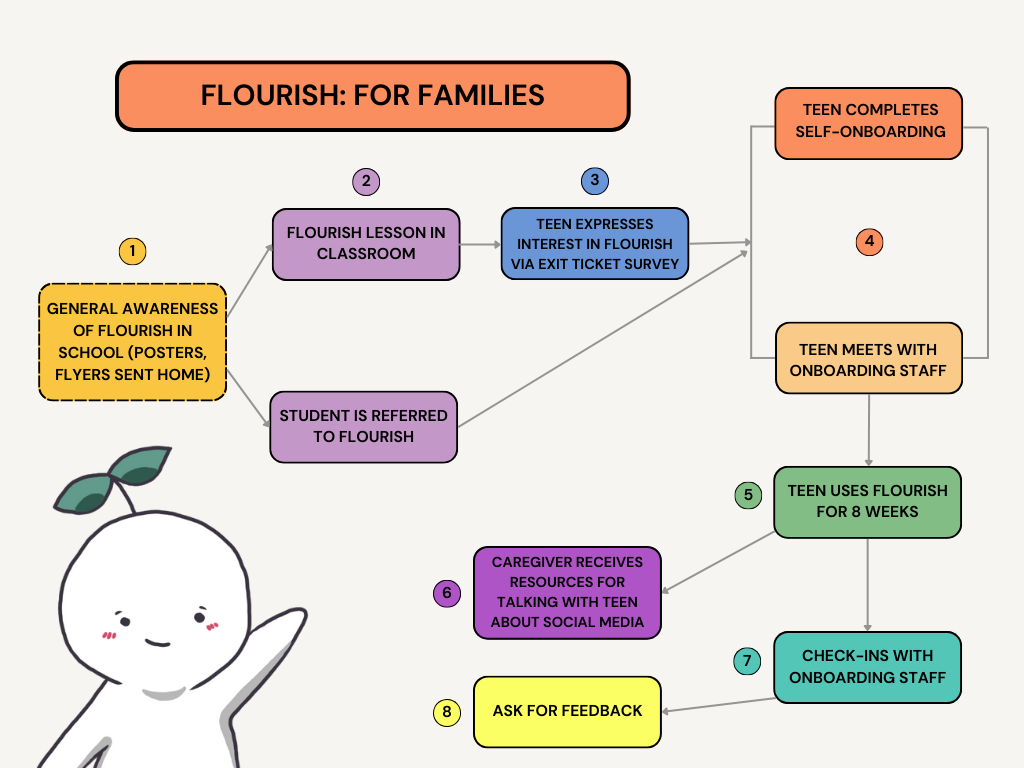
See below for information on parental involvement in the study.
Negative online interactions include things like:
- Overt name calling, insults, and threats
- Covert activities such as rejection, exclusion, and spreading rumors
- Identity-based bullying based on aspects of self (gender, race, ethnicity, sexual identity, etc.)
- Hate speech
- Exposure to negative or triggering content
These experiences are strong and consistent indicators of mental health consequences with an estimated 30% of youth affected.
We recognize that social media can have both positive and negative effects. See below image for more information.
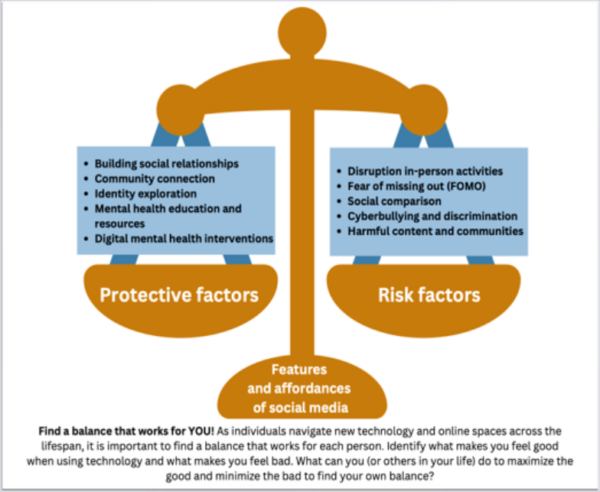
(Hamilton et al., 2023)
Students can be referred to Flourish by a staff member at school who thinks they might benefit. We ask that school staff keep these criteria in mind, but it is ultimately up to them who they recommend and anticipate would find the program helpful.
- Experiencing symptoms of depression, anxiety, or suicidal thoughts and/or behaviors within the past 3 months
- Recent negative online interactions, such as receiving upsetting text messages or social media posts that left them feeling upset, made fun of, picked on, or afraid
Students may also “self-refer” to Flourish by endorsing interest in the program after participating in a classroom lesson about social media and online interactions if they foresee a benefit in using it based on the same criteria detailed above.
While Flourish is directed toward youth, the caregiver role is important. We encourage you to educate yourself about social media (this can be done with all kinds of resources, one we like is Connect Safely) and have conversations with your child about their social media use. You can refer to these guides from the Cyberbullying Research Center about how to have conversations with your child about online interactions, social media, and Flourish use. You can find more helpful resources on our website here.
Caregivers also have a role in this study as far as providing informed consent, being available to support youth in using Flourish during the intervention period, and being available during study appointments to discuss risk and safety if it comes up.
While Flourish is still being clinically tested, there have been…
- Qualitative interviews with X school staff, 21 caregivers, and 40 teenagers informed the program’s focus and how it could be implemented.
- Codesign with 55 youth – youth were involved in creating every inch of Flourish to maximize its potential for it to be youth-friendly and youth-informed.
- Usability tests with 20 teens, which delivered high scores suggesting satisfaction with Flourish and that is useful to youth. Flourish was perceived as:
- A positive and caring tone
- Easy to understand
- Well-organized
- Containing meaningful content
- An open trial of 11 youth found Flourish:
- Helpful (4/5 on a helpfulness scale with 5 being the highest)
- 25% reduction in suicidal thoughts
- Improved coping skills, such as improvements in tolerance of distressing emotional states
The research we have conducted to date and the feedback we have received from students, caregivers, educators, and community members brings hope that Flourish’s rollout in schools will promote awareness and maintain conversations about teen mental health and suicide prevention at school and community levels.
Flourish also encourages students to utilize coping skills, reach out for help, and build awareness of positive versus negative online interactions.
Recent trends suggest that suicide rates in adolescents are increasing, so it is important now more than ever to implement well-researched tools that can help mitigate this risk.
Flourish discusses topics such as:
- Online interactions (text messages, social media comments, direct messages, etc)
- Distress levels
- Skills for coping with distress, problem solving, talking to a trust adult, reporting and blocking others on social media
- Support for underserved identities
- How to help a friend who is impacted by online negativity
Your child’s privacy is important and taken seriously. Flourish is designed to be confidential, and data is stored securely on private, HIPAA-compliant servers or cloud platforms managed with similar privacy protections in place as medical records. Any phone numbers or other contact information put into Flourish are kept secure and will not be contacted with promotional material.
Some data at a macro level will be provided to the school so they can understand students’ usage and helpfulness of the program. It is helpful for schools to know the big picture, for example the number of students using Flourish, the skills used most often, and if there is a correlation between student usage of Flourish and how they rate their general wellbeing. Additionally, individual usage data will be provided to the schools, for example if a student is not engaging with Flourish, someone from the school staff may reach out.
We know from talking to youth that privacy is an important factor in reaching out for help. They value independence and want the capability to have private conversations with Flourish. Because of this, Flourish does not share texts or specific information on usage with parents or caregivers. Still, you can monitor your child’s use of Flourish in the same way you may already monitor their phone use. If you want to be more involved in your child’s use of Flourish, please see a guide from the Cyberbullying Research Center or other resources on the Flourish website for help with talking about online interactions, social media use, and Flourish with youth.
Your child will not be asked private questions about their mental health while using Flourish. Any information gathered about mental health during study procedures is kept private. Information may be shared with parents or caregivers in accordance with safety management, such as if a student is at risk of harm to themselves or others.
Flourish is a texting program, so if your child has a phone plan that does not account for unlimited text messaging, message and data rates may apply.
Flourish is maintained by study staff at the University of Pittsburgh. Flourish is programmed with a “red flag” procedure, where if a student texts words that are flagged as dangerous, research staff will be notified. Then, a safety procedure would follow including checking in with the student and parents/caregivers. If there is a legitimate concern that the school should be aware of (e.g., that relates to the safety of students), a designated member of the school staff would be notified that this occurred using a secure email, but safety is managed by the research team.
Because of concern of burden on school staff, it will not be the school’s job to monitor or check in about Flourish use. However, the Flourish in Schools research study contains a text coaching procedure in which a student will be contacted 2-3 times over the course of the study by a health coach, who is a trained mental health clinician, to check in about goals, progress, and any questions they may have about Flourish. These contacts will be over text or phone based on preference.