Planning Phase
Roles within each school context should be clearly defined and individualized. The different roles that need to be assigned could include an individual or a planning committee that facilitates rollout of the intervention (rollout facilitator). The rollout facilitator would be the individual or team who manages Flourish implementation at the school level in collaboration with the research team. If a planning committee is selected, it would focus on planning and working in collaboration with administration. Standard payment for a planning committee could be $30-40/hour.
If onboarding staff (school staff facilitating onboarding students to the intervention) are different than the rollout facilitator, they would be identified at this time. Then, the planning and onboarding personnel would decide with administration what information should be collected from Flourish and what outcomes to measure (see evaluation section).

If schools have a no-phone or limited cell phone use policy, some options could be to bookmark flourish.pitt.edu on school devices, or designate a space (i.e. guidance office) where students can use their phone to access Flourish during the school day.
Firstly, existing trainings around mental health, bullying, and suicide prevention can be built upon to build general staff knowledge around Flourish. Then, Flourish-specific training would be provided to onboarding staff, rollout facilitators, and/or planning committee. This training should be framed as how it could benefit school staff, the school environment, and the community as a whole to generate buy-in.
There are options for trainings. They could be asynchronous, which would give staff time to complete them on their own time over the summer with other mandatory trainings. Or they could be synchronous, the advantage being that staff would have an opportunity to ask questions. These synchronous trainings could be offered on professional development days to limited added burden.
School counselors could be trained at staff meetings on onboarding if they are identified as the onboarding facilitators. Training could be framed as an opportunity to build relationships with students as they complete check-ins with Flourish. Synchronous training would be helpful to have the opportunity to ask questions and try using the intervention.
Lastly, other school staff who might interact or make referrals to Flourish should be trained asynchronously but have the opportunity to try using Flourish.
If a school has a threat assessment team, they would be trained on red flag words and problem solve liability at that particular school. However, this will be managed by the research team at present.
Consent can be collected as a) passive or b) active process.
A passive consent process could look like a letter being sent home to families with infographics describing the Flourish intervention, a lesson plan (if using option 3), and an FAQ. There could also be an automated email sent to families notifying them of their child being referred to Flourish (option 1 or 2) or that their child expressed interest in Flourish (option 3). This could also include a video to watch explaining Flourish.
The active consent process might look like a presentation for parents to learn about Flourish in an in-person or virtual setting, like a parent education night. In this setting, it would be important to emphasize that Flourish is not a Tier 1 intervention – it is not for everyone, but those who might benefit from it could practice social-emotional learning skills. Then, the passive consent materials might be sent as well, but with the opportunity for parents/caregivers to sign off on the services. If parents/caregivers have concerns or questions, the onboarding staff will be provided with resources and conversation guides for how to answer families’ questions and respond to their concerns. An individual or team at the school will also need to be identified in the case of active consent to ensure they obtain parental consent.
Implementation Phase
To refer a student to Flourish, a SAP liaison, school counselor, or other school staff might first weigh the student against inclusion/exclusion criteria determined by the school on a case-by-case basis.
Staff might discuss with the onboarding team or planning committee how to identify students who could benefit from Flourish if they are not going to see the school counselor.
One consideration is that school nurses could help identify who could be a good fit for Flourish by connecting them with the clinical team.
Lastly, staff could review past risk assessments and teacher reports to identify who might benefit from Flourish once it becomes available at a school.
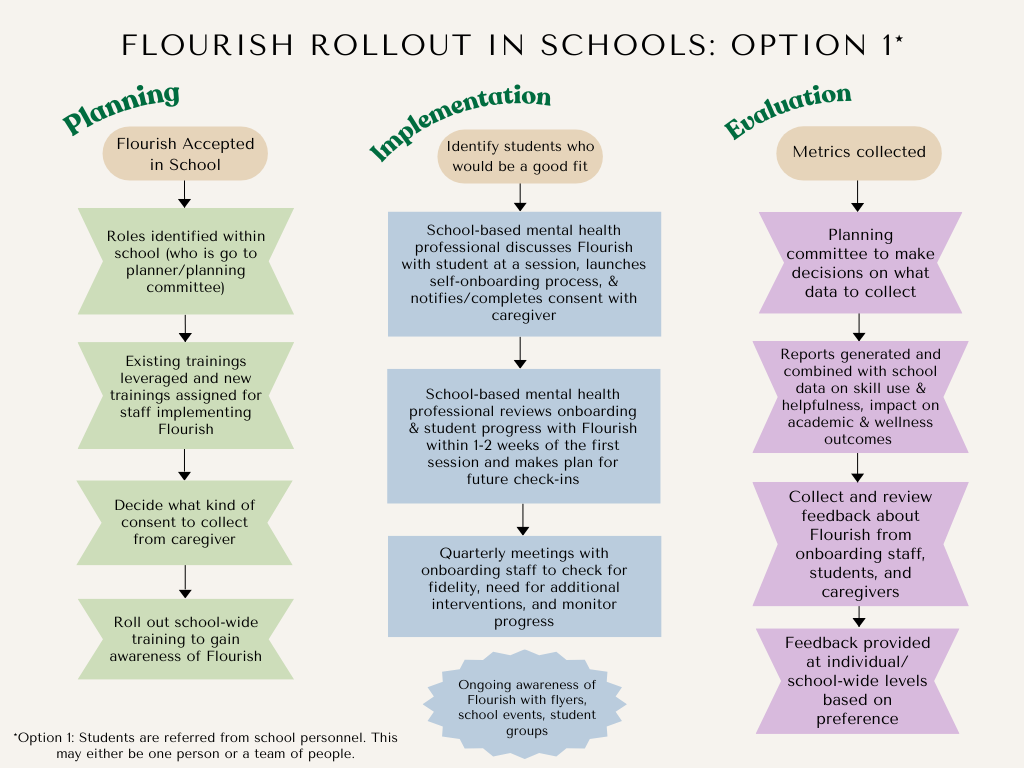
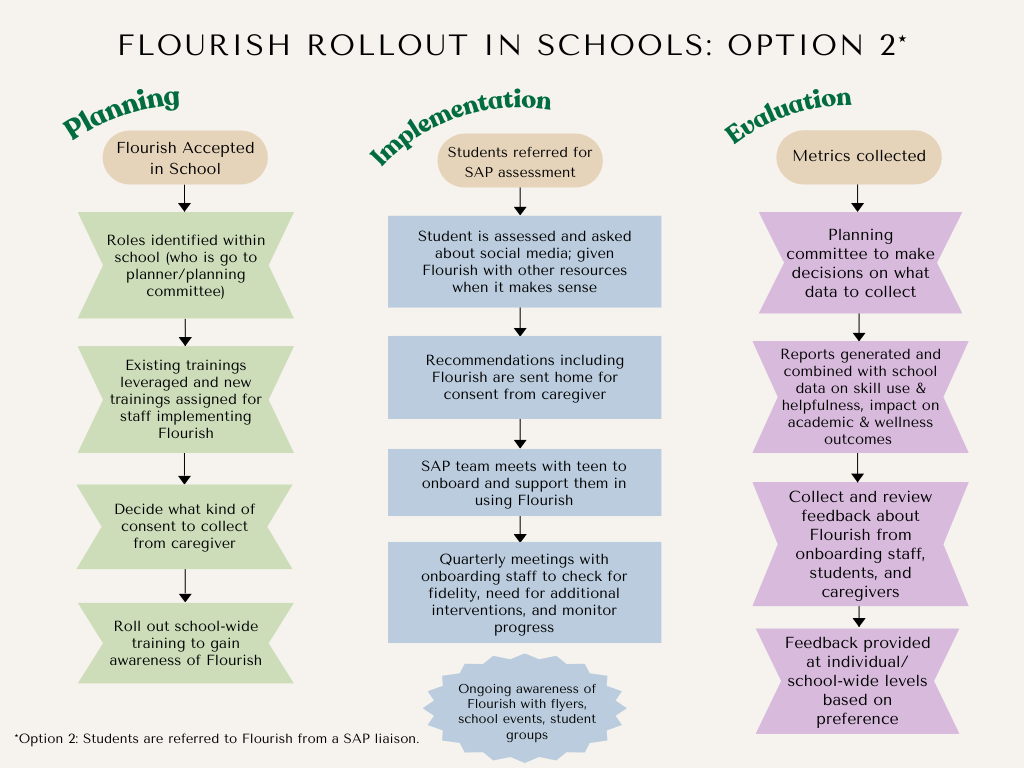
Option 2 utilizes the SAP team to refer students to Flourish. This flow might look like Flourish first being included in the permission letter from SAP liaisons. Then, a student could be referred to the SAP team by a school counselor, teacher, or family member. When the SAP team assesses the student, they could ask some specific questions about social media. The SAP team would then determine what resources should be provided to the student with Flourish offered if it fits. The student would then meet with the SAP team to learn more about Flourish. If they are interested, a recommendation letter would be sent home to the family with suggested resources, including Flourish, with resources for a parent as well. This flow would request active consent from the parent or caregiver. There would not be an expectation to sign and return the letter but rather give them some say in treatment. If the parent/caregiver declines Flourish, then the SAP team would move on with other resources. Lastly, if the student and family agree to utilize Flourish, they would be onboarded with a SAP liaison at which point the timeline for check-ins would be determined.
If a school has a school-based therapist on staff and option 1 is in effect, this person ideally will complete onboarding to Flourish (after referral) and use their regular weekly sessions with students to check-in about Flourish use.
There could also be a utilization report generated that goes directly to the school-based therapist to follow up on to reduce attrition.
With this option, students would have a defined start and stop date for using Flourish. This is designed to reduce the burden on the therapist, so they do not have to monitor use on an ongoing basis, but only during a designated intervention period. At the end of the intervention period, students could be given a certificate for closure and to bring attention to relevant metrics.
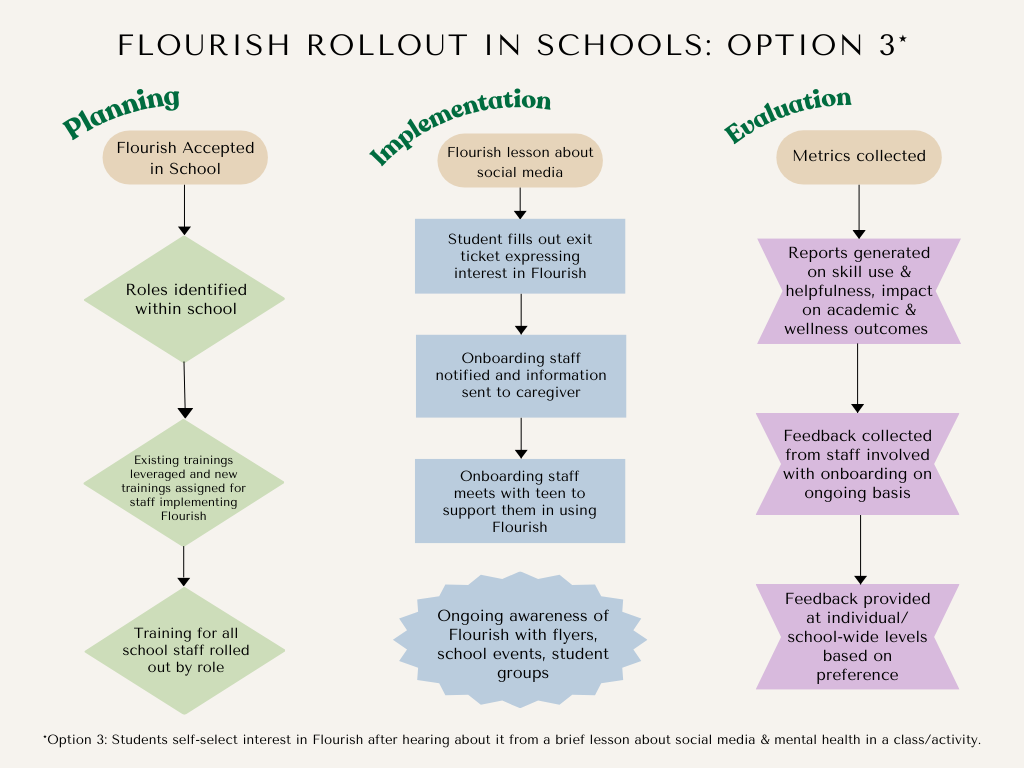
During the Flourish lesson, one recommendation is to have onboarding staff, if possible, drop in during the lesson to put a face to who would be getting students set up on Flourish.
If a parent opts their child out of the lesson, the school can offer an alternative option like responding to an essay prompt or a counselor check-in to still give the student an opportunity to learn about protecting themself on social media and reflect on the nature of their own online interactions.
Some options that can help keep Flourish fresh in the minds of students and school staff are:
- Mentioning Flourish during the morning announcements
- Posting about Flourish on the school website, as an article or a resource
- Posting about Flourish on parent resource websites
- Displaying posters around school (see materials for awareness)
- Integrating Flourish with existing clubs and student events (e.g. around suicide prevention)
- See a full list of options here
In a large school, it is likely that multiple rollout options would be used at once. The advantage to multiple pathways to Flourish access is that more students are identified who could benefit without putting too much burden on one individual or team.
Evaluation Phase
Starting with the school board, the Flourish implementation team or planning committee needs to decide what metrics to share with the school board. It could be helpful to find out what metrics are most important to measure and analyze. At the community and school level, the team can consider if we want to collect quick statistics to be incorporated into community or parent meetings or school assemblies. On an individual level, it is critical to decide what information will be shared with parents/caregivers. Some considerations could be if a student called a crisis hotline from Flourish, if red flag words were identified, or a general report about usage, what skills they have been using, and perceived helpfulness.
Specifically for option 2, aggregate data could be developed for the school board to review helpfulness in addressing needs and changes in risk assessment before vs. after Flourish use for individual students.
Currently, some ideas of metrics could be at the school level or at the individual level. We could also incorporate existing data that schools are already collecting from students.
At the school level, we could measure:
- Percentage of students using Flourish, of the number of students who expressed interest in Flourish (via referral or exit ticket interest)
- Information about helpfulness of Flourish skills and activities
- Impact on the number of students attending in-school counseling visits
- Top skills being utilized school-wide
- Data on if Flourish is finding students in need of services who are not currently receiving any
At the individual level, we could measure:
- Are high risk students using Flourish more and the difference in their usage
- Impact
- Helpfulness as a self-management tool
Leveraging existing data about:
- Change in individual level information from existing surveys
- Overlay usage and results from Flourish questionnaires with grade, gender, and race statistics
- Integration of data on attendance, grades, discipline reports, monitoring from People’s Services Meetings, and mental health outcomes
Specifically for option 2, one metric we could explore is comparing the number of crisis referrals, nursing visits, classroom avoidance, and psych-related hospitalizations with Flourish use. There could also be of review how often referrals are coming in for Flourish and the burden on threat management team.
From the onboarding team, we can collect qualitative feedback on if they need further support. We could also use surveys to collect information with the option to follow up more in detail. We could provide an incentive, like a gift card or free food, ask to complete the survey as part of professional development, or send the survey from a trusted source.
We could also meet with student groups to learn about their specific usage. Similarly, we could send students an evaluation survey to ask about helpfulness and acceptance with some open-ended questions to get specific details.
More specifically for option 1 and 2, we could ask parents to give feedback on helpfulness with emotional regulation at home and outside of school. We could also ask clinical staff who made the referral for feedback about what they have noticed has changed in the students they see, any changes in frequency of risk assessment, orr any impact on risk level.
Supervision of onboarding staff could be conducted on an as-needed basis. We would review the number of students using Flourish, engagement, and helpfulness ratings. In time, this could be developed into a staff portal.
One option is this could look like quarterly oversight meetings. In these meetings, we could meet with onboarding staff to check for fidelity and need for additional interventions, compare current data to baseline timepoints to monitor progress, overlay information from “warning signs” like low attendance and poor or dropping school performance, evaluate coping skills and triggers from Flourish data, and create updates for administration, leadership, and families. In a large school, this could even look like a press release.
It is important to consider what kind of data is being monitored and sent. One option could be sending the data to the counselor to then contact the parent/caregiver.
If using red flag words, we need to manage liability with who is monitoring this risk. In option 2, this could be the risk management team, but with options 1 and 3, there would be more to consider.
Ideally, data would be kept as anonymous as possible for confidentiality but would need something like a student ID to cross-reference when integrating existing student data with Flourish metrics.
One evaluation flow could look like:
- Ongoing reports timed based on anticipated usage (i.e. weekly)
- Measure of psychological distress given regularly (i.e. weekly) to assess helpfulness of the intervention
- Reports generated and integrated with school data on usage and helpfulness, as well as impact on academic and wellness outcomes
- Collect and review feedback about Flourish from onboarding staff, students, and caregivers
- Reports and feedback provided to clinical staff for follow-up and to school board for assessing helpfulness
We could have additional surveys customized by the school that collect specific information that the school is interested in, e.g. “did you see a counselor while using Flourish?”
In the future, we could also integrate Flourish with the existing electronic systems in schools to overlay with student mental health outcomes that is already being collected.